
Media


News
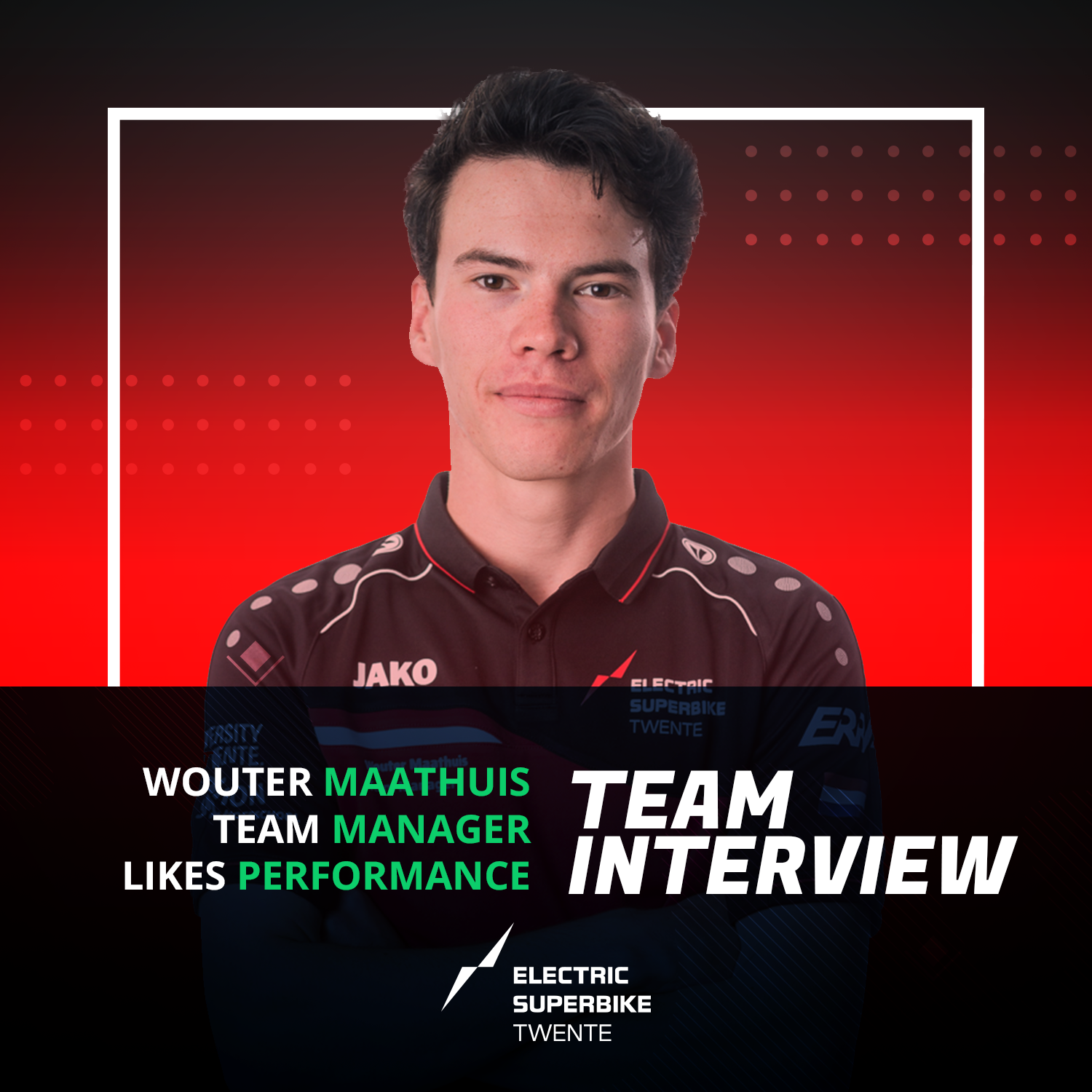
Team Interview: Wouter Maathuis
My name is Wouter Maathuis and I am Electric Superbike Twente’s Team Manager. I joined this team because I was looking to further develop skills that are not addressed in my study program (which is Technical Medicine). My attention was drawn by the student teams because they are composed of a variety of people with a lot of different backgrounds. The fact that Electric Superbike Twente works on (one of) the fastest motorcycles made choosing one of the student teams not that difficult. I have always been interested in motorsport and speed so joining EST was a no-brainer.
What is your personal goal this year? 
My goal is to get familiar with all aspects that come into play when managing a team of eighteen people. How do you keep everyone motivated? How do you keep an overview of everything that is going on in the team? How do you cope with unexpected problems? These are some of the questions that were going through my mind when I started. I think that my goal is to find the optimal balance between interfering with the subteams and letting everyone do their own thing.
What is your biggest achievement as the team manager so far?
This is a hard one. I find that my work is in general not that tangible. I try to keep the motivation high and steer the team away from potential pitfalls. The fact that we are getting closer together as a group is something that I am proud of.
Do you believe that your superbikes will be able to beat MotoE bikes?
Of course. All of our components are designed by us and tailors to our specific applications. This leads to us having a bespoke and state of the art motorcycle. This combined with the amount of energy that everyone puts into the team makes that I can only be optimistic. The motivation and drive of the team will make it happen; I am sure of it!
What is your dream opponent?
Our goal for this year is to beat MotoE bikes. However, I am also very curious how we would compete against internal combustion vehicles. Finding out what the key differences are in terms of power delivery, cornering ability and overall performance is something that I think would be very interesting to find out. With that in mind, something like a MotoGP bike or supercar would be really cool to race against!
What do you experience managing a team of 18 people?
The main thing I noticed was that I need to be in contact with a lot of different people. I remember being overwhelmed by the amount of questions that were asked to me during the first weeks. Once everyone settled into their function on the team, the benefits of a relatively large team became clear. It leads to a lot of different insights into problems and questions. This provokes discussions which lead to better and more creative solutions. However, a large team also requires good communication and a clear structure. I think that that is one of my challenges for this year.
Technical Tuesday: Connection box DELTA-XE
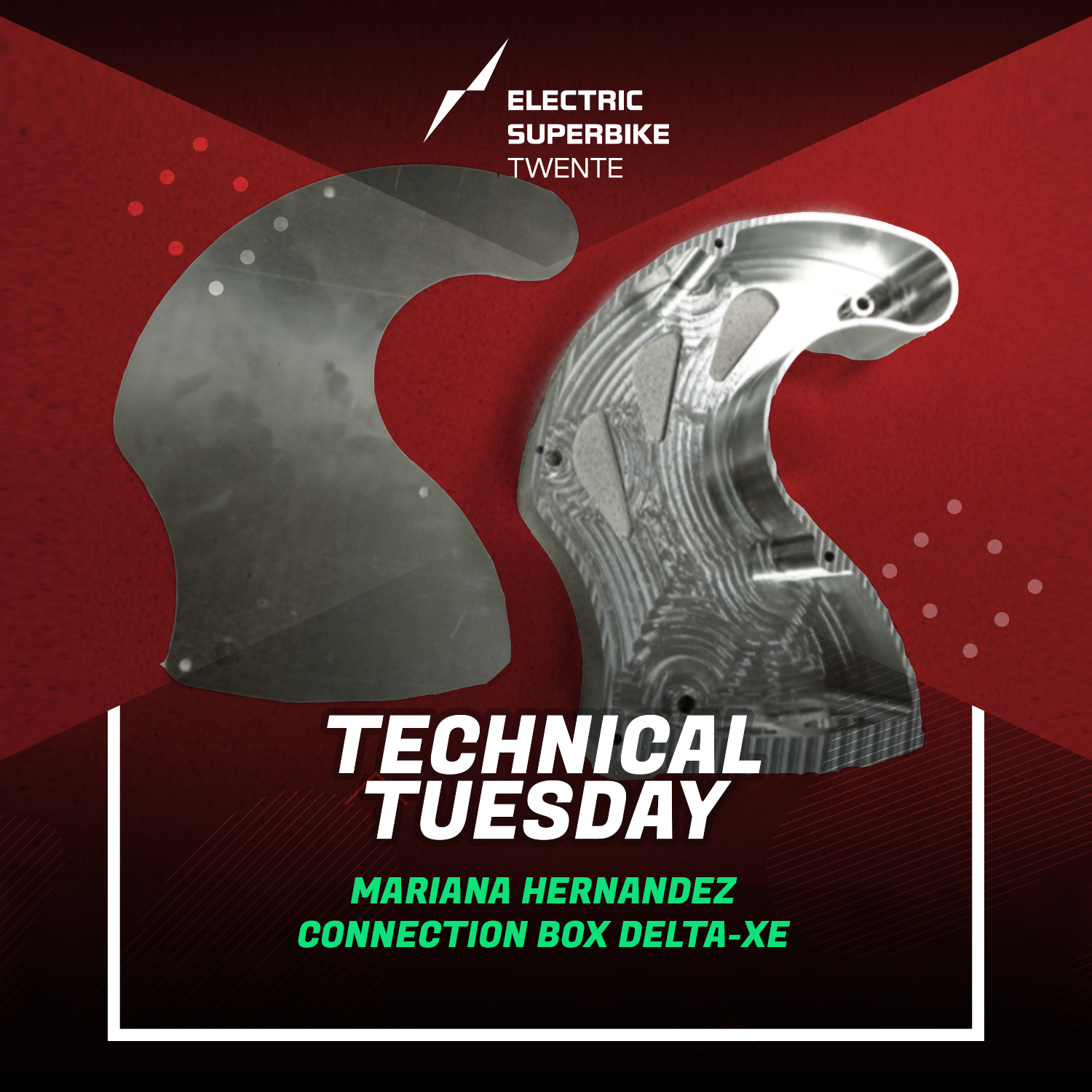
The connection box is a housing component for the electromotor high voltage cables. This housing is attached directly to one of the motor’s lids from the outside shielding the high voltage cables from external damage. The initial prototypes for the connection box were 3D printed with thermoplastic in order to get an optimized design as well as for testing potential materials. Yet, the main requirement for the connection box this year was for it to be manufactured using metal.
Having this requirement, a list of manufacturing processes was compared, such as metal 3D printing, casting and CNC milling. Due to the feasibility of the design and keeping costs in mind, the connection box was designed for CNC milling. For this process in particular several considerations need to be taken into account. For instance, the radius size of the fillets, which are limited to a minimum size of 4.5mm due to the CNC machine capabilities. Also, the diameter size of the cable holes, since 6 out of 9 needed to be threaded with a tap. Completing design for manufacturing, the final concept design was taken to the Hangar at the University of Twente for machining. The team of technicians at the Hangar aided the team in discussing the feasibility for manufacturing and design feedback. At the end, the connection box was CNC milled with Aluminum 7075. And not only the connection box itself was required to be of metal but also the rest of the component in the assembly. Thus, manufacturing the top lid with laser cutting out of sheet metal. As well as properly selecting the cable connectors from our partner Helukabel.
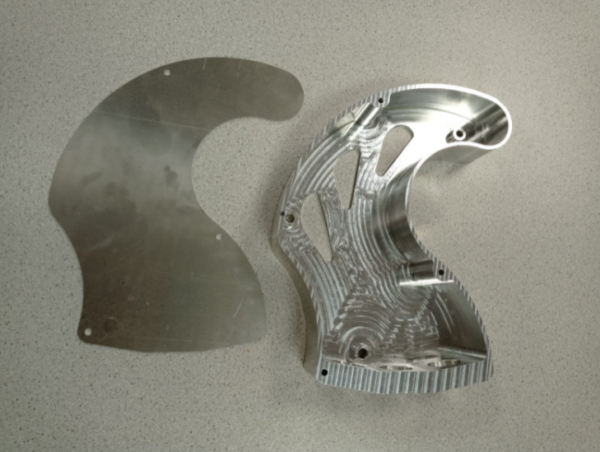
So why exactly did the connection box was required to be manufactured out of metal? The main purpose of effective electromagnetic compatibility shielding is to prevent electromagnetic interference (EMI) from impactive sensitive electronics. This is achieved by using a metallic screen to absorb the electromagnetic interference that is being transmitted through the air. The shield effect is based on a principle used in a Faraday cage – the metallic screen completely surrounds either the sensitive electronics or the transmitting electronics. The screen absorbs the transmitted signals, and caused a current within the body of the screen. This current is absorbed by a ground connection or a virtual ground plane.
Yet, to avoid electromagnetic interference as much possible and for safety reasons, we also need to shield the high voltage cables from one another when assembled inside the connection box. For this, a separate component was designed to function as a cable guide to shield the cables from touching each other as well as from touching the lid and connection box. Since this component wasn’t required to be manufactured out of metal, it was 3D printed at the Future Factory.
With this new connection box, the team can perform tests to the electric superbike in a safer way due to the proper shielding of the high voltage cables.
– Mariana Hernandez